The Blind Piano Tuner Who Played Only Three Bars
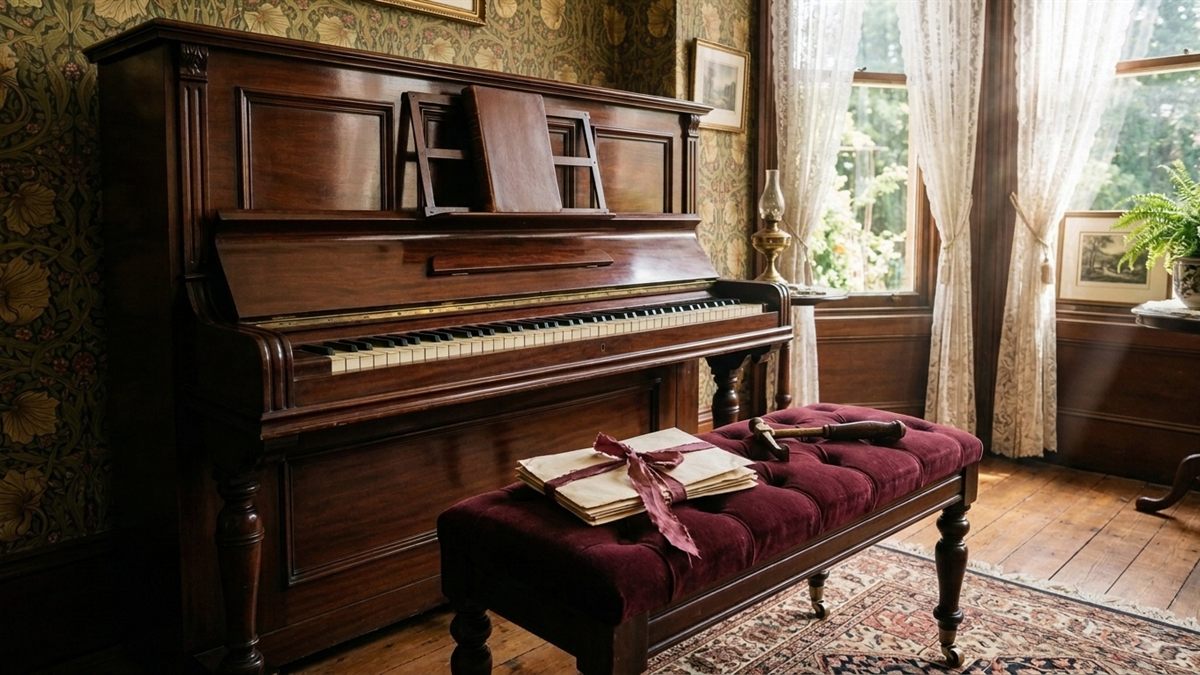
When Rachel inherited her great-aunt Evelyn's sprawling three-story boarding house on Hawthorne Street, the attorney handed her a brass ring of keys and one yellowed calendar note taped beside the kitchen clock: October 14 — Mr. Keller tunes the parlor piano. Pay him fifty dollars in cash, and let him play.
Rachel assumed Mr. Keller was simply an old neighborhood tradesman Aunt Evelyn kept on retainer out of charity. When the appointed Friday arrived, a frail eighty-year-old man wearing round dark glasses and carrying a canvas tuning roll tapped gently up the front porch steps right at two o'clock.
He worked in total silence for nearly an hour, tightening steel pins with quiet precision until every octave rang clean and bright. Then, before packing his brass tuning hammer back into its leather pouch, Mr. Keller rested his fingers lightly on the middle keys and played three slow, haunting bars of a minor-key lullaby—stopping abruptly right on an unresolved flat note before folding his bench lid down.
"Thank you, Miss," Mr. Keller said softly, accepting the fifty-dollar bill with a polite bow. "Evelyn always liked to hear whether the lower register still held its pitch."
"Who wrote that melody?" Rachel asked as she walked him toward the porch. "I grew up hearing Aunt Evelyn hum those exact three notes while baking bread, though I never found sheet music for it."
Mr. Keller paused at the screen door, a faint sad smile touching the corners of his mouth. "A young composer who rented room six during the winter of 1962," he said gently. "Never finished the fourth measure before the flood took the old music store downtown."
What Was Hidden Beneath the Music Bench
Something about the way Mr. Keller spoke—and the strange deliberate cutoff on that same unresolved note—lingered in Rachel's mind long after October ended.
Two weeks later, while stripping faded crimson velvet off the padded piano bench seat so she could reupholster it before winter guests arrived, Rachel noticed two tiny brass screws concealed underneath the corner molding—screws that didn't hold the frame legs together, but bolted a thin cedar false bottom inside the sheet-music storage tray.
Using a stubby kitchen screwdriver, she backed both screws out and lifted the cedar slat.
Resting underneath in a wax-paper wrap wasn't sheet music. It was an unmailed stack of twelve letters tied in faded blue ribbon, addressed to Evelyn Hawthorne in a neat, slanted hand signed simply Arthur K., accompanied by a yellowing 1963 newspaper clipping about a fire at the Riverside Conservatory that left a promising young pianist permanently blinded while pulling two students out of the stairwell.
Reading Between the Unfinished Measures
Rachel sat cross-legged on the parlor rug and read every single letter until dusk darkened the streetlamps.
Aunt Evelyn and Arthur Keller hadn't been mere landlady and tradesman. In 1962, Arthur had been an impoverished music teacher renting room six upstairs, composing a wedding piece for Evelyn—whose stern father forbade her from marrying a penniless boarder and threatened to cut off the boarding house mortgage if Arthur stayed past spring.
After the fire at the conservatory took Arthur's sight the following winter, Arthur broke off their secret engagement out of stubborn pride, refusing to let Evelyn spend her youth nursing a blind husband who could no longer read a score.
Yet he never moved out of town. And Evelyn never married anyone else.
Instead, every October for half a century—even after Evelyn's stern father passed away and she turned the house back into quiet guest rooms—Arthur returned once a year as "just the piano tuner," playing the exact three unfinished bars of their wedding lullaby so Evelyn would know he was still alive and safe across town, while she quietly slipped fifty dollars into his palm because he refused to accept charity.
Why hadn't Rachel known? Because Evelyn had kept Arthur's letters sealed under the cedar slat until she grew too frail to lift the heavy oak bench herself—and left that calendar note so someone would still invite Mr. Keller inside when October came around.
Answering the Fourth Measure
The next Friday afternoon, Rachel didn't wait for next October. She drove across town to the modest brick duplex listed on the conservatory pension directory, carrying the wax-wrapped letters inside a small linen bag.
When Mr. Keller opened his door and recognized her voice in the hallway, his hands trembled slightly around his white cane.
"Aunt Evelyn kept every single note you ever wrote her inside the piano bench," Rachel told him softly as they sat beside his kitchen radio. "And she never once tuned that upright with anyone else."
Arthur bowed his silver head silently for a long minute, touching the faded blue ribbon with scarred fingertips. That Sunday afternoon, for the first time in more than sixty years, Mr. Keller returned to Hawthorne Street not with a canvas tool bag—and when he sat at the polished upright in the sunny front parlor, his fingers didn't stop at bar three. He played the gentle fourth measure all the way to its final warm chord.